
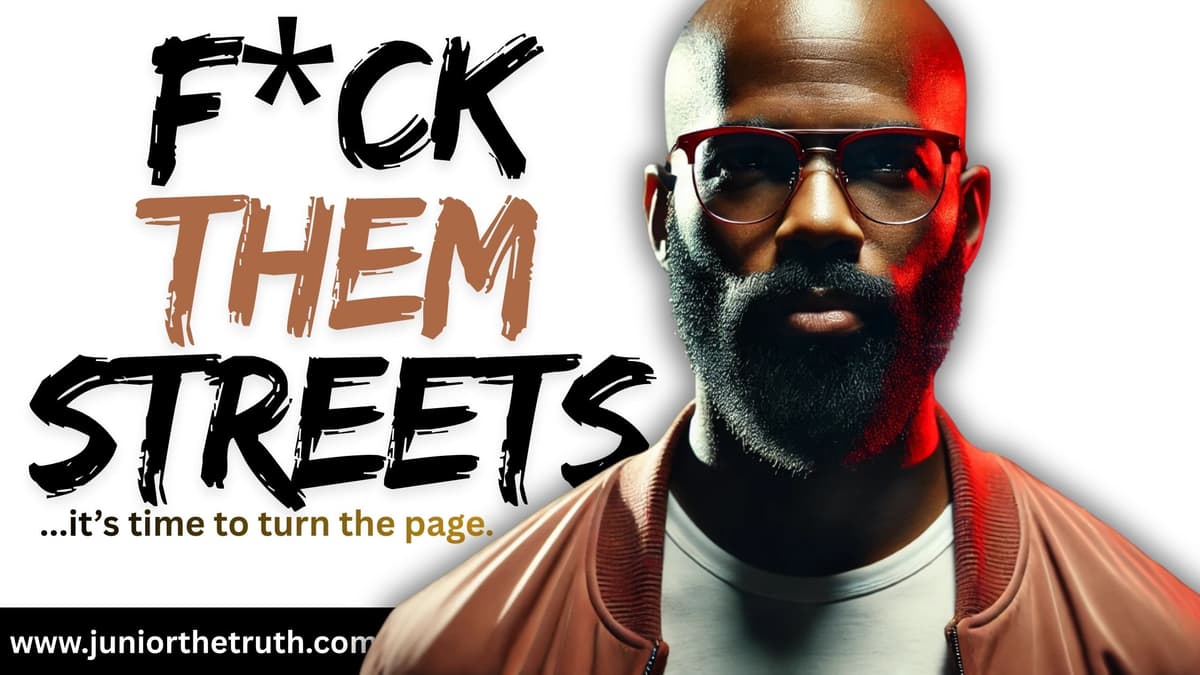
There comes a point in a man’s life—especially for Black men raised in survival culture—when something inside finally snaps into clarity.
It isn’t about rejecting where you’re from.
It isn’t about disowning your people or pretending the streets didn’t shape you.
It’s about rejecting a mindset that demands everything from you and promises nothing in return.
That moment usually sounds like this:
“F*ck the streets.”
But here’s the truth most people never talk about—saying that isn’t the end of the journey. It’s the beginning. And if you walk away from the street mindset without replacing it with something more substantial, more structured, and more intentional, you don’t grow. You drift.
This conversation isn’t about the streets.
It’s about what comes after.
The Street Code vs. the Self-Mastery Code
The street code is built for survival. It runs on reputation, retaliation, and emotional dominance. Respect is enforced, not cultivated. Decisions are fast, reactive, and fueled by ego, pride, and impulse.
Self-mastery operates on a completely different frequency.
A mastery code is rooted in vision, discipline, and responsibility. Instead of reacting to disrespect, it evaluates consequences. Instead of letting emotion dictate behavior, it leans on principles and standards.
The street code might win approval today.
The mastery code builds peace, stability, and legacy tomorrow.
A fundamental question worth sitting with is this:
Which code actually serves you at 40 or 50 years old—the one that impresses people right now, or the one that protects your future?
Identity Detox: Who Are You Without the Streets?
For a lot of men, the most challenging part of leaving the streets isn’t changing behavior—it’s losing the identity that came with it.
Street credibility becomes personality.
Trauma turns into status.
Survival stories become introductions.
So when that identity gets stripped away, there’s confusion. Emptiness. Even fear.
That discomfort doesn’t mean you’re failing. It means you’re finally standing at the starting line.
Self-mastery requires an identity detox. It means rebuilding yourself on character rather than chaos, on values rather than validation, and on purpose rather than reputation. If you can’t explain who you are without referencing past battles, beefs, or blocks, then the deeper work hasn’t started yet.
Accountability: Where Power Comes Back Home
There’s a moment in every man’s growth where blaming the environment stops working.
Yes, the streets shape behavior.
Yes, conditioning is real.
Yes, circumstances matter.
But self-mastery begins the moment responsibility replaces excuses.
Accountability isn’t about shame. It’s about reclaiming power. When you say, “I chose this—and I can choose differently,” you take control back from the past.
Ownership isn’t punishment.
Ownership is freedom.
Raising the Price of Access to You
In survival culture, access is cheap. Everyone can reach you. Every crisis becomes your problem. Every emotional situation demands your attention.
Self-mastery changes the rules.
You start setting standards for your time, your energy, and your emotional availability. Not every call gets answered. Not every conversation gets entertained. Not every problem becomes yours to solve.
When you raise the price of access to yourself, some people will fall away. That’s not a loss. That’s alignment.
Emotional Mastery: From Reacting to Responding
Street culture trains men to react instantly. Any perceived disrespect demands an immediate response. Pride stays on high alert.
Self-mastery trains restraint.
Anger, ego, and pride lose their grip when you learn how to pause. Sometimes silence is the power move. Sometimes walking away is the win.
Real strength isn’t loud.
It’s controlled.
Your future is worth more than your feelings in the moment.
Money Mastery: From Fast Money to Real Freedom
Fast money feels powerful—but it rarely lasts.
Street money doesn’t build assets, credit, or protection. It creates short-term comfort while sabotaging long-term security. When it disappears, the lifestyle collapses with it.
Self-mastery shifts the focus to freedom, money, skills, ownership, credit, legitimate business, and systems that work while you sleep.
Ask yourself this honestly:
If everything connected to the streets disappeared tomorrow, what part of your life would still stand?
That answer tells you whether you’re building or just surviving.
You Can’t Grow in a Chaos Crowd
Growth requires a different environment.
If your circle constantly replays old stories, glorifies dysfunction, or resists change, your progress will slow down. Distance doesn’t always mean disloyalty—it often means evolution.
Loyalty to your future has to outweigh loyalty to shared stagnation.
The right circle challenges your thinking, raises your standards, and normalizes discipline.
Healing the Pain Beneath the Image
A lot of street behavior isn’t toughness—it’s unprocessed pain.
Loss.
Poverty.
Abandonment.
Humiliation.
Trauma.
The streets teach armor, not healing.
Self-mastery demands inner work. That might look like therapy, journaling, prayer, meditation, or long, honest conversations with yourself. Healing isn’t weakness. It’s a strategy.
You can’t build a new life while dragging old wounds behind you.
If Not the Streets… Then What?
Walking away from the streets without a vision creates Emptiness.
Self-mastery needs direction. Family. Legacy. Entrepreneurship. Leadership. Service. Something bigger than survival. Discipline without vision eventually collapses.
Picture your life ten years from now if you stay on a mastery path. Let that image guide your decisions today.
Turning the New Code Into Daily Practice
Self-mastery isn’t theory. It’s lived.
Early mornings.
Structured days.
Physical training.
Skill development.
Mental discipline.
The same intensity once used to chase street respect can be redirected into building stability and purpose. Chaos loses its appeal. Consistency becomes the flex.
Redefining What It Means to Be Real
Being real isn’t about how much damage you’ve survived—or caused.
Being real means integrity.
Discipline.
Responsibility.
Protecting life instead of destroying it.
The shift is simple but profound:
You stop proving you’re willing to die for the streets
and start proving you’re willing to live fully for your purpose.
If you’ve said “Fck the streets,”* the next move is yes to self-mastery.
Anything else is just another way of being lost.
— JuniorTheTruth™